“Are We Blind Too?” (Part 2 of 2)
Ministries > Truth For Life with Alistair Begg
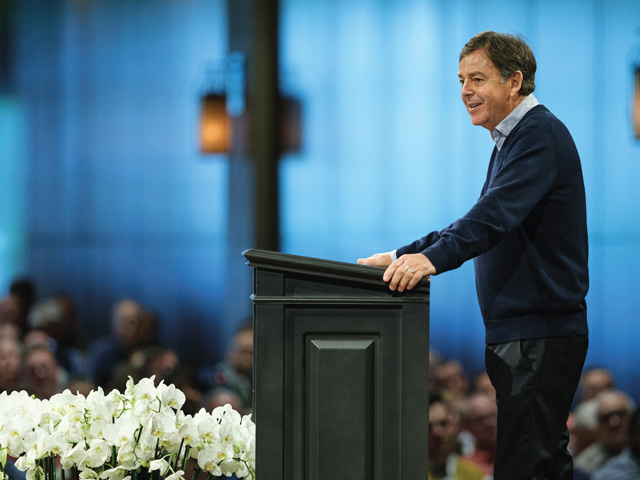
 Learning about Jesus eventually brings each one of us to a “crossroads moment.” On Truth For Life, Alistair Begg explores the options and their consequences. Which way will you turn? Study along as we wrap up a series titled A Light in the Darkness.
-----------------------------------------
• Click here and look for "FROM THE SERMON" to stream or read the full message.
• This program is part of the series A Light in the Darkness’
• Learn more about our current resource, request your copy with a donation of any amount.
• FREE AUDIOBOOK! In our polarized culture, disagreement is often seen as combative and offensive. What if there were a way to do it well? Download your free copy of The Art of Disagreeing by Gavin Ortlund and master how to disagree with kindness and influence. Request yours at ‘truthforlife.org/disagree.’
Helpful Resources
- Learn about God's salvation plan
- Read our most recent articles
- Subscribe to our daily devotional
Follow Us
YouTube | Instagram | Facebook | X
This listener-funded program features the clear, relevant Bible teaching of Alistair Begg. Today’s program and nearly 3,000 messages can be streamed and shared for free at tfl.org thanks to the generous giving from monthly donors called Truthpartners. Learn more about this Gospel-sharing team or become one today. Thanks for listening to Truth For Life!
Alistair Begg: Learning about Jesus eventually brings each one of us to a crossroads moment. Which way will we turn? Today on Truth For Life Weekend, we'll explore the options and the consequences. Alistair Begg is teaching from chapter 9 in John's Gospel, beginning with verse 39.
Alistair Begg: We have spent obviously the vast majority of time looking at the incident concerning the healing of the man born blind. This man was awakened to the fact of his spiritual blindness. He might have thought that his greatest need in life was in order to have his physical sight restored, which of course, Jesus had done.
Alistair Begg: But when all is said and done, Jesus seeks him out in order to ask him a question, the question that is found in verse 35, "Do you believe in the Son of Man?" And the response of the man is eager. He is genuinely interested, "Who is he, sir?" the man asked, "Tell me, so that I may believe in him."
Alistair Begg: And he stands in direct contrast to the Pharisees who refused to see what was right before their noses. They were the ones who claimed to have the sight, but they were in fact the ones who were blind to the truth. They regard themselves as the guides of the blind. You can read that in Romans 2. They regard themselves as a light that shines to those in the darkness. They regard themselves as instructors of the foolish.
Alistair Begg: Paul mentions all of that when he is arguing to the point in Romans 3, where he says, "And so the whole world is accountable before God, whether you are a Gentile coming from that background, or whether you are a Jew, feeling yourself to be the custodians of all of this truth." And so it makes their question all the more striking, doesn't it? One can almost hear the almost see the sneer on their faces. "What, are we blind too?"
Alistair Begg: Sense the smugness of their tone, catch a flavor of the derision directed at Jesus. You can just see this. You know that horrible feeling when you're in a room somewhere and everybody else thinks they're in the know, and they ask a question and they and they just are dissing you and and and they look at one another like, "You know, and you just feel so small and so impoverished by it all." That's what they're doing. They're looking at one another going, "So, are we blind too, are we, Jesus?"
Alistair Begg: Yeah. But blind they were. So blind. They didn't know how blind they were. They're like the man in Luke 18. Remember the wonderful parable Jesus tells of the Pharisee and the tax collector.
Alistair Begg: And to those confident in their own righteousness and who look down on everybody else, Luke says in Luke 18, Jesus told the story. Context is clear, isn't it? To those who were confident in their own righteousness, to people who were sure they could see, to people who were dead certain that they were not the blind people. To those who were confident in their own righteousness and look down on everybody else, all those poor people who can't see, Jesus told a parable.
Alistair Begg: There were two men who went up to the temple to pray. One was a Pharisee and the other a tax collector. The people nudged one another, "Here we go, good good guy, bad guy." The classic Jesus story. There's a good fellow and a bad fellow. I wonder what this one's about. And the Pharisee stood up and prayed about himself, "God, I thank you, I'm not like other men."
Alistair Begg: "Robbers, evildoers, adulterers like this tax collector here. After all, I fast twice a week, I give a tenth of all I get." People would be going, "That's pretty good. Pretty good." Giving him marks out of 10. Jesus said, "But the tax collector stood at a distance. He would not even look up to heaven, but he beat his breast and said, 'God have mercy on me, a sinner.'" And then the sting in the tail.
Alistair Begg: Jesus says, "I tell you that this man, the tax collector, went home justified before God." "For everyone who exalts himself like the Pharisees, who think they can see, will be humbled. And whoever humbles himself will be exalted."
Alistair Begg: Do you remember the Simeon statement now, holding the baby in his arms, what did he say? "This child is destined for the falling and rising of many in Israel." Until a man or a woman falls at the feet of Jesus and says, "I am a blind man, I am a blind woman," they will never rise to see.
Alistair Begg: As long as we sit in the supercilious perspective of the religious formalist, declaring, "You know, I have been around church for a long time. My my my Uncle Jim gave me a Bible when we were married. I I know that because I saw it just the other day, hadn't seen it for years, but I know it's somewhere. You know, that all that kind of thing. I'm so glad that I don't need to trust in Jesus. I'm so glad that I'm like the Pharisee in this story. I'm I'm not like other men."
Alistair Begg: "And actually, I've really upped my contribution since I came here as well, although I don't expect you to know much about that." Jesus turns the whole thing on its head. "Well, you're not suggesting that we're blind, are you, Jesus?" You see, our response to Jesus shows what we think of ourselves, and our response to Jesus shows what we think of Jesus.
Alistair Begg: And what they think of Jesus is just actually that he is deluded, that he's a madman, that he's demon possessed. We saw that before. It comes again in chapter 10. "Why listen to him?" they said. "He's demon possessed and raving mad." And that for me is one of the great and intriguing things. How it is that people continue to come and listen to the Bible being preached, and actually you've already made your decision concerning Jesus. You've decided that Jesus was either deluded or he was deceitful.
Alistair Begg: Unless you move from one of those two positions to acknowledge that he is who he is, that he is the light of the world and that those who follow him will not walk in darkness, then you walk out into a darkness that that that is just completely utter darkness. Now look at how Jesus answers. Verse 39, there's a division. Verse 40, there's a question, and verse 41, there's an answer.
Alistair Begg: The answer that he gives is a puzzling answer. It's certainly not an easy little verse, is it? They were probably expecting Jesus to say, "Yes, you are a blind bunch," or "No, of course you're not blind. You're the Pharisees. You have all the all the news strapped around your wrists and fastened on your forehead. You've got all the Old Testament scriptures right there, right at your right at your hand."
Alistair Begg: And they probably expected either a yes or a no. But instead of doing that, he does what he does so often, that is he just reaches in and twists their noses a little bit, by responding in what is a paradoxical fashion. Now, let me just quote to you Philip's paraphrase of this verse because I think it will I think it will help us get the sense of it.
Alistair Begg: Philip's paraphrase of verse 41, which here reads, "If you were blind, you would not be guilty of sin, but now that you claim you can see, your guilt remains." It's like a really bad riddle, isn't it? You can say it to you say it to yourself 15 times in a row and still not get it. But listen to how Philip does it. "If you were blind," returned Jesus, "nobody could blame you. But as you insist, 'We can see,' your guilt remains."
Alistair Begg: If you were blind, you couldn't be held accountable for your ignorance. That's what he's saying. But since you insist, you can see, your guilt remains. Now, if you think about it, these folks, of all folks, knew the characteristics of the Messiah who was to come. They were the ones who searched the scriptures. They were the ones who paid attention to the prophetic passages. They knew Isaiah 42. They knew that one of the characteristics of the Messiah when he came was that he would open the eyes of the blind. He would release captives. He would set people free from dungeons. And this has happened right in front of them.
Alistair Begg: Jesus in setting the man to see physically, has revealed the fact that he is the only one who can bring spiritual sight, that he has provided as John says, one of the signs, evidence, so that people might believe that Jesus is the Christ, that they might believe that Jesus is the Messiah, that they might believe that all of the Messianic prophecies have been fulfilled in this man, and that by believing they might have life in his name. And this has happened in front of them.
Alistair Begg: The man has said to them, "Your unbelief is more remarkable than my cure. Because we know that only God can do this. There is no record of anybody doing this," he says. "God does this." And before their very eyes, Jesus has done what God alone can do. If they'd been without any understanding of spiritual things, then of course, they wouldn't have been blameworthy.
Alistair Begg: But because they have a knowledge of this stuff, they're culpable because they are unwilling to see beyond the horizon, as it were, of the Old Testament. And their condemnation lay in the fact that although they knew what they knew, and claimed to see as well as they did, they failed to recognize God's son when he came.
Alistair Begg: Fulfilling what we read in the prologue, he came to his own, and his own received him not. But to as many as received him, who believed in his name, to them he gave the power to become the sons of God. Now what makes this so staggeringly telling, loved ones, is this.
Alistair Begg: That their sin remains because until they admit to their true blindness and come into the light, there is no hope for comfort or forgiveness. And what is true of them is true of each of us this morning. Let me say two things as we move to a close on this.
Alistair Begg: There is absolutely no hope for those of us who are wise in our own eyes. There is no hope for those of us who are wise in our own eyes. Solomon puts it in Proverbs 26:12, "Do you see a man wise in his own eyes? There is more hope for a fool than for him." That's why the prophet says, "Let not the wise man boast in his wisdom."
Alistair Begg: "Well, I'm a PhD, I did nuclear physics as an undergraduate and." Good. Bring that gargantuan brain and all that gray matter and bow it down before the Lord of the universe. "No, I refuse to." Okay. Let not the wise man boast in his wisdom, or the strong man boast in his strength.
Alistair Begg: "You know, I am X years old and I can still do X number of push-ups and sit-ups and run 47 times around the block and everything else." Well, that's terrific. Bring your body as a living sacrifice to the God who made you and offer yourself in service to him. "No, I don't want to do that." Okay. Let not the strong man boast in his strength.
Alistair Begg: And let not the rich man boast in his riches. "You know, I've done very, very well and I can get into most clubs and I travel extensively and I have a home here and a home there." Is your home built on rock or is it built on sand? I don't know. It should be a good time to find out. There is no hope for those of us who are wise in our own eyes.
Alistair Begg: And there is no cure for people who reject the only cure there is. There is no cure for people who reject the only cure there is. There's an inherent logic in this, loved ones. If Jesus Christ is Lord, if Jesus is the person he claimed to be, then his exclusive claims with his expansive invitations drive us to the inevitability of a conclusion which is reacted to vociferously in contemporary America and in the West in particular.
Alistair Begg: There is no cure. I was reading Macbeth again this week, looking for something and for two reasons actually, the first was this. When I thought about the nature of a cure, my mind went immediately to to to Lady Macbeth in the sleepwalking scene, when she is convinced of the fact that the blood that was on the daggers is still on her hands.
Alistair Begg: And if you remember, she moves in the darkness of the night, talking to herself, longing for the spots to be out of her hands, recognizing that despite all of her physical washings, she cannot get it out. All the perfumes of Arabia could not get rid of this stuff, she says, and she's driving herself almost insane, and she's driving her king husband completely nuts along with her.
Alistair Begg: And so he does exactly what you would expect him to do. He takes her to the doctor, and he says to the doctor, quote, "Cure her of that. Canst thou not minister to a mind diseased? Pluck from the memory a rooted sorrow? Raise out the written troubles of the brain and with some sweet oblivious antidote, cleave the stuffed bosom of that perilous stuff which weighs upon her heart?"
Alistair Begg: The doctor says, "Therein the patient must minister to himself." "Sorry, no can do." And then he says, "More need she the divine than the physician. More need she the divine than the physician." I would not be at all surprised if there are not those who today, sitting, listening to me, on one side of this great divide as the bell is about to ring for us in the conclusion of this sermon, are not exactly as in Lady Macbeth's position.
Alistair Begg: Oh, the circumstance may not be bloody daggers, but it may be a myriad things, and all of your external washings and all of your endeavors and all of your perfumes and everything that you've tried, have left you absolutely hopeless. Let me tell you, there is no cure when you reject the only cure there is. He breaks the power of canceled sin and he sets the prisoner free. He is Jesus, sovereign Lord of the universe.
Alistair Begg: He has demonstrated it in the transformation of this blind man. He has confronted him with his need of spiritual sight. He has opened up a door of opportunity to the religious formalists, and they sneered in their response, "You're not saying we're blind, are you?" And so here we are, and the division bell sounds again. The question is, will you respond by coming into the light, admitting your blindness, casting yourself on his mercy, and as a result, find yourself seeing and saved?
Alistair Begg: Or will you refuse to come to the light, claiming to hang on to your own personal sense of illumination? If you take the latter route, you go out into a darkness in which no light will ever shine. Who would be foolish enough to say such things to an intelligent group like this? Well, of course, if I couldn't turn you to the Bible and point you to Jesus, you you should just chase me completely out of town.
Alistair Begg: And you are sensible people, and you need to figure this out. But here's the deal. The division bell sounds. Go to your appropriate lobby. Where are you going? With a yes vote for Jesus, or a no vote for Jesus? There's no abstentions. An abstention is a no. A maybe is a no. I'll get back to it is a no. Now, that's why the Bible always says, "Today if you hear his voice, do not harden your hearts." Why? It is a call of God's mercy because on another day, you may not hear his voice. This may be the day you hear his voice.
Alistair Begg: Therefore, do something about it. I was in Carmel earlier last week. I was in the Santa Cruz Mountains speaking, and I went to Carmel. In Carmel, I bought myself a knife in a knife store. The more knives than I've ever seen. Tiny little knife, don't be alarmed by it. My wife was desperately concerned, I said, "I want to buy a knife." She said, "What do you have in mind?" I said, "Don't worry." But it's a tiny little knife. I just I I wanted to whittle sticks with it, as it turns out. It's the Tom Sawyer coming out in me again.
Alistair Begg: And in this store, there were so many knives that I said to the lady, "The problem in here is the American problem." I said, "It is the American problem, and it is the American wonder." She said, "Choice?" I said, "Choice." And so we got them out, one at a time, two at a time. At one point, I had five out. And then I went away and I had lunch and then I came back and got them all out again.
Alistair Begg: And I said, "You know, choice is such a difficult thing, isn't it? Just finally making a choice." Do you know what she said? "Kierkegaard has a very interesting essay on that." "Wow!" I said. "This is taking it up a notch. Kierkegaard, the existentialist from the 19th century. Yes." "Whoa, what did he say?" "She says, Kierkegaard said that even good choices had negative consequences." "So hurry up and buy a knife!"
Alistair Begg: So I bought a knife. And then I said to my family, "You know, Kierkegaard said that good choices have negative." And then one of the bright ones in the group said, "I don't think Kierkegaard was absolutely right on that. What possible negative choice could there what negative dimension could there be in choosing Christ as your savior?" I said, "Yeah, I think that's right." So hurry up and make a choice, would you?
Alistair Begg: Do you remember Do you remember when Macbeth is getting ready to kill the king? King Duncan. And he's he's on his way. And parenthetically the stage directions in the in the play say, a bell sounds. A bell sounds. And Macbeth says, "I go, and it is done. The bell invites me. Hear it not, Duncan, for it is a knell that summons thee to heaven or to hell."
Alistair Begg: See, Shakespeare understood the divide. There is no cure for those who reject the only cure there is. Will you not come to Christ and say, "Lord Jesus, I am a blind girl. I am a blind man, wise to my own destruction, foolish in my arrogance. Make me see. Make me see." And he will. And when you begin to see, you will see everything differently.
Alistair Begg: Heaven above is softer blue and earth around is sweeter green and something lives in every hue that Christless eyes have never seen. And birds with gladder songs o'erflow and earth with deeper beauty shine. Since I know as now I know, I am his and he is mine. Some of you could stand and testify, couldn't you, and say, you know, I'm so glad that I heard that message and because I used to be just completely lost.
Alistair Begg: I used to be completely blind and even when I was blind, I thought I could see everything. Well, you may want to mention to the person next to you before before you leave today, just check, make sure. Just say, "What side are you on of the divide here? What side are you on?"
Alistair Begg: You're listening to Truth For Life Weekend with Alistair Begg. Alistair returns in just a moment. If you're still not sure how to answer Alistair's closing question, visit our website truthforlife.org. You will find sermons there to help you learn what the Bible says about Jesus, about the gospel, about what it means to follow Christ. You can dig deeper by searching the sermon archive by topic or by scripture to find answers to your questions.
Alistair Begg: The Bible is clear that God wants to connect with us. He reveals himself in many ways, including through his creation, and this month we are recommending a book titled The Language of Rivers and Stars. How Nature Speaks of the Glories of God. The book is both unique and beautiful, and the reflections invite you to slow down, to enjoy the world God has created, the sky, the seas, the plants and the animals. As you do, you'll experience a deeper connection with God.
Alistair Begg: Through a biblical understanding of what he is saying to us through his creation. This is the last weekend we are recommending this book, so be sure to check out The Language of Rivers and Stars when you visit our website at truthforlife.org. Now, here is Alistair.
Alistair Begg: Father, come now and write your word in our hearts. Anything that is foolish, or unkind, or unwise, or untrue, may be banished from our recollection. And what is of yourself, make it our own. I pray for many who sit as unconverted believers that today they might hear your voice, not harden their hearts, and embrace Christ who is the light of life. For it's in his name we pray. Amen.
Alistair Begg: Thanks for listening. How can we reconcile what we know about our good God with the moral and social chaos we see around us? That's the question we'll consider as we begin a study in the book of Habakkuk next weekend. Join us as we explore the answer. The Bible teaching of Alistair Begg is furnished by Truth For Life, where the learning is for living.
Related Episodes
Those Who Have Hope (Part 2 of 2)
Friday, August 28
Those Who Have Hope (Part 1 of 2)
Thursday, August 27
Christians Grieve Too! (Part 2 of 2)
Wednesday, August 26
About Truth For Life
Truth For Life distributes the unique, expositional Bible teaching of Alistair Begg. Studying God’s Word each day, verse by verse, is the hallmark of this ministry. In a desire to share the good news of the Gospel without cost as a barrier, the entire teaching archive is available for free download and resources are available at cost with no markup.
About Alistair Begg
Alistair Begg has been in pastoral ministry since 1975. Following graduation from The London School of Theology, he served eight years in Scotland at both Charlotte Chapel in Edinburgh and Hamilton Baptist Church. In 1983, he became the senior pastor at Parkside Church near Cleveland, Ohio. He has written several books and is heard daily and weekly on the radio program, Truth For Life. The teaching on Truth For Life stems from the week by week Bible teaching at Parkside Church. He and his wife, Susan, were married in 1975 and they have three grown children.Contact Truth For Life with Alistair Begg
Website
http://www.truthforlife.org/?utm_source=oneplace&utm_medium=sitelinks&utm_campaign=home
Mailing Address
Truth For Life
P.O. Box 398000
Cleveland OH 44139
Telephone (Customer Service)
888-588-7884 Domestic
400-543-6800 International
440-543-0522 ( Fax)


