Elizabeth and Zechariah (Part 2 of 2)
Ministries > Truth For Life with Alistair Begg
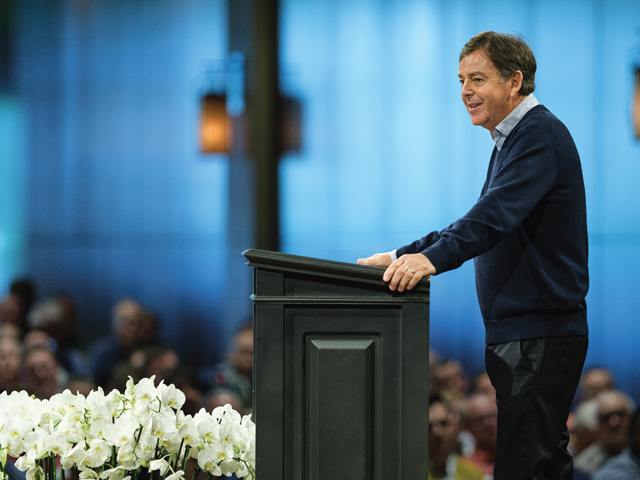
 Do you ever question why God puts up with all the wickedness in this world—why He’s so slow in fulfilling His promise to return and judge the unrighteous? Find out why His delay is actually an act of compassion. Listen to Truth For Life with Alistair Begg.
-----------------------------------------
• Click here and look for "FROM THE SERMON" to stream or read the full message.
• This program is part of the series ‘History, Mystery, Divinity’
• Learn more about our current resource, request your copy with a donation of any amount.
Helpful Resources
- Learn about God's salvation plan
- Read our most recent articles
- Subscribe to our daily devotional
Follow Us
YouTube | Instagram | Facebook | X
This listener-funded program features the clear, relevant Bible teaching of Alistair Begg. Today’s program and nearly 3,000 messages can be streamed and shared for free at tfl.org thanks to the generous giving from monthly donors called Truthpartners. Learn more about this Gospel-sharing team or become one today. Thanks for listening to Truth For Life!
Bob Lapine: You ever wonder why God puts up with all of the wickedness in this world? Why he is so slow in fulfilling his promise to return and to judge the unrighteous? Today on Truth For Life Weekend, we'll learn why his delay is actually an act of compassion. Alistair Begg is continuing our study of God's mysterious work through the lives of ordinary people, people like Elizabeth and Zechariah, the elderly parents of John the Baptist. We're looking today at Luke chapter 1.
Alistair Begg: So if you imagine them as a couple, here they are. He goes to his priestly duties, he comes home, they have a nice meal together, they talk about the fact that life has unfolded as it has, the twilight of life is now a shadow upon them, they huddle together, they pull the blanket over their knees, and they think about where they've been, and they ponder the prospect of the future, and they have no children to brighten up their day or to cause them concern. She is childless, she is barren. It stood as a symbol of the fact that somehow or another, it would appear that God had been displeased with her. That's the way they thought of it. So culturally, the context is deep darkness, and personally, there's a shadow over their home. But their names would be a help to them. When they spoke to one another in the morning, they were actually not simply giving each other a designation that would be helpful by way of identification, but also affirming certain things that were true of God. Because Zechariah actually means “the Lord remembers,” or “the Lord watches over you.” In Psalm 121, “He watches over your going and your coming from this time forth and even forevermore.” All of that is wrapped up in the name Zechariah. And Elizabeth means “My God is an oath,” or “My God is faithful,” or, if you like, “My God keeps his promises. So in the morning, when she woke up and she reached over and she reached out for Zechariah, she said, “Good morning, Zechariah, how are you?” Zechariah was a reminder to us that the Lord is watchful. And he says, “I’m okay, Elizabeth. Did you sleep?” She said, “Yes, I did.” He said, “You know, Elizabeth, the Lord is faithful.” I don’t know what the future holds for us. I don't know if we'll live a long time or a short time. But I do know this, that God is all that God has pledged himself to be. And this God is at work in the darkness, and this God is at work in unlikely ways. And thirdly, this God is at work in the line of duty. In the line of duty. Because he was serving as a priest, verse 8 tells us, when his division was on duty, according to the custom of the priesthood, he was there to do what he had to do. Now, he would have been well known in the temple. After all, there was no retirement for priests. Retirement for Levites, but not for priests. So he was going full steam ahead. They would have seen him day after day and week after week when it came his time, and so on, and he would perform the functions that were assigned to him. But now something very significant has happened. This is verse 9: “He was chosen by lot to enter the temple of the Lord and burn incense.” Again, you’re going to look at that and say, “Well, that’s very interesting. I thought that’s what priests did in any case.” No, no, you need to understand something. This is highly significant. There was only one temple, but there were thousands of priests. Josephus, the Jewish historian, estimated conservatively that there were twenty thousand priests that served in the temple. And the assignment for the burning of incense, although it took place in the morning hour and in the evening, was an assignment that was made as a result of the drawing of lots. So what were the chances that your name was going to get pulled? Well, you can do the mathematics. Don’t confuse me. It wasn’t strong. In other words, what is described here in verse 9 is essentially a once-in-a-lifetime event. All right? So in the course of his routine activities, he is now given an assignment which is a privilege and which is largely unique. And the whole multitude, verse 10 says, that they were praying outside at the hour of incense, so that within the temple courts, there were various courts. He is now going into the holies, not the holiest of the holies, but he's going in there to perform his function. And in the courts, the multitude has gathered, and they are praying at the time of the burning of the incense, praying outside at the hour of incense. So it was a very specific thing. And there appeared to him an angel of the Lord. Just when he's got his chance to do the one burning of incense routine, he gets interrupted. Before he can get the whole thing put in place, an angel of the Lord. Mystery. Angels. Mysterious. An angel of the Lord. Divinity. At the routine hour of the burning of the incense. History. And his reaction is the normal reaction of people when they see angels. If you check with the rest of the Bible, you can concur with what I'm suggesting. And Zechariah, verse 12, was troubled when he saw him, and fear fell upon him. He didn't go like, oh, hey, thanks, nice to see you. Glad you could come. Well, I got my shot at it today. No, no, no, no, no. He was troubled. Remember in While Shepherds Watched Their Flocks by Night? I always have to work really hard on that one because of being a naughty schoolboy. But anyway, While shepherds watched their flocks by night, all seated on the ground, an angel of the Lord came down and glory shone around. Fear not, said he, for mighty dread had seized their troubled minds. The invasion of eternity into time, of divinity into humanity, the engagement of that which is mysterious in the routine activities of priestly function. And in this encounter, Zechariah is to discover that God is not only at work in the darkness, not only at work in these unusual ways, not only at work in the line of duty, but also at work in the gift of a son. Do not be afraid, Zechariah, for your prayer has been heard. What prayer? You say, well, we're looking at you. I mean, you're the one who studied it, right? No, but I want you to think about that for a moment. What prayer? The prayer that he's been praying in the context of his duty here, the immediate existential prayer that he's been praying? Or praying for a son? Do you think he's praying for a son? I take it that he wasn't praying for a son. I mean, when I just read this, and I read and it says, “Your prayer has been heard, and your wife Elizabeth will bear you a son.” If it said, “Your prayer has been heard for your wife Elizabeth will bear you a son,” then I would think there's much more of a direct correlation between the two, but I don't think so. After all, he's old. He's aged. There's no indication that they would have... Why would they be praying for a son? They already decided, we don't have a son. That part's over. This isn't Sunday. Right? And when he's told about this, it's not actually the reaction that you would expect from someone whose fervent prayer has been answered. No, I think that his prayer is the prayer of others like him, like Simeon in chapter 2. Simeon, whom we find in the temple. Remember, Simeon’s the one who is able to say, “Lord, let your servant now depart in peace, because my eyes have seen your glory.” And what was Simeon doing? He was waiting for, praying for the consolation of Israel. And as a devout Jew, Zechariah would be doing the same thing, praying, "O God, come into our darkness and shine your light. Come into our silence and speak your word. Give to us your word. We need to hear your word. For hundreds of years, we have heard nothing from you at all, and the place is so horribly dark." And the angel says, "Hey, your prayer has been answered, and has been answered in a way that will, frankly, exceed your expectations, because your wife Elizabeth will bear you a son, and I have his name for you as well. You're going to call him John, which means Yahweh shows grace. And," verse 14, "the result of this will be for you joy and gladness, and not only for you, but many, verse 14b, will rejoice at his birth. I don't think that means will rejoice on the day of his birth, but will rejoice at all that his birth gives rise to, that the occasion of the birth of this child will be the foundation of rejoicing for many, many people. And you need to know, he says, that he will be great, great before the Lord. That's really great. See, true greatness is greatness before the Lord, who searches the hearts of everyone. If we determine greatness in terms of human approbation, we've gone wrong on greatness. The only great you want to be is great before the Lord, because it’s before the Lord you’re going to stand one day, and he knows the up from the down and the in from the out, and he knows your motives, and he knows everything about you. So to be great before the Lord is to be really great. He will be great before the Lord. Remember, Jesus says in Matthew 11 of him, says, “There was none born of woman who was greater than John the Baptist.” He’ll be great. He will be godly. Specific instructions here along the lines of a Nazarite vow. Whether he was really a Nazarite or not, you can study for your homework. But we don't want him filled up with wine or strong drink. He will be filled with the Holy Spirit. He will be godly, he will be great, and he will go. Where will he go? No, he will go before him in the spirit and power of Elijah. Now, turn back just for a moment to the last book of the Old Testament. I'll just show this to you here as I think about it. Matthew chapter 4. Malachi chapter 4, sorry, I beg your pardon. And at the very end of it, it's only four chapters, and here's the promise of God through his prophet Malachi. Verse 5 of Malachi 4: “Behold, I will send you Elijah the prophet before the great and awesome day of the Lord comes, and he will turn the hearts of fathers to their children and the hearts of children to their fathers, lest I come and strike the land with a decree of utter destruction. So here we have the end, as it were. Malachi is not chronologically the end of the story, but it is the final book that we have in the layout of the Old Testament in our Bibles. So it ends with the prospect of one who will come in the spirit of Elijah. Here we go back to Luke 1, verse 17, and the angel says, “And he will go before him,” that is, before the Messiah, “in the spirit and power of Elijah,” to do exactly what Malachi said was going to happen, to turn the hearts of the fathers to the children. Now, clearly, our initial notion on this is to think in nuclear terms, at least mine was. Also, he turns the hearts of the fathers to the children. But if you think about it, do you remember what Jesus said? He says, I actually didn't come to bring, you know, cohesion, I came to bring division. You know, and as a result of me, you know, fathers will be opposed to their children, and children will be opposed to their things, and so on. The dividing line will be in Jesus. So what does it really mean? I think it means simply this: that the prophets of old—and you can read this in Isaiah, again, do your own research—but Isaiah speaks, for example, of Jacob in Isaiah 29. He speaks about how Jacob is saddened by the fact—and Jacob was one of the fathers of the faith. You're the God of Abraham, Isaac, and Jacob. They are, if you like, the fathers. And Jacob bemoans the fact that those who are, quotes, his children have turned away from the living God. And the promise here is that John the Baptist's ministry will be such that those who, along the lines of God's unfolding drama, have become simply those who are going through the motions. These people, under the ministry of John the Baptist, will actually now come to turn their hearts to the fathers and to the faith of their fathers, so that they will no longer draw near simply with their lips while their hearts are far from them, but they will draw near heart and soul. I find this tremendously encouraging that God is at work in all of this. He'll turn the hearts of the fathers to the children, the disobedient to the wisdom of the just, and to make ready for the Lord a people prepared. To make ready for the Lord a people prepared. We say it all the time, don't we, that it is God's unmistakable purpose from all of eternity to put together a people that are his very own. And here, in an obscure environment, in the home of an aging couple, an aging childless couple, the drama of God's redemptive purpose is unfolding before our eyes. Maybe this should be the final point for this morning, that God is at work even when God's servant reacts poorly. God's at work even when God's servant reacts poorly. The response of Zechariah is not exactly what you would call positive, is it? And Zechariah said to the angel, "How shall I know this? For I'm an old man, and my wife is advanced in years." In other words, any chance of a sign? He's not bowing down in worship, is he? He's doubting. I find that kind of encouraging. His uncertainty cannot thwart the unfolding plan of God, as becomes apparent. How shall I know this? Look at me. And if I show you my wife, she's in the same position. And the angel answered him, "I am Gabriel, who stands in the presence of God." You're not just talking to any old angel here, he says. I am Gabriel, who stands in the presence of God, and I was sent to speak to you. I mean, this isn't my idea. I'm on a divine appointment, and I was sent to speak to you and to bring you this good news. He's a gospel messenger, if you like. There's a whole sermon in that as well, which we'll leave for another time. I stand in the presence of God. I was sent to speak to you and to bring you this good news. And by the way, yes, you're getting a sign. Verse 20: And behold, you will be silent and unable to speak until the day that these things take place, because you did not believe my words. Wow. Note well: if we do not believe God’s words, we shut ourselves up to judgment. If we do not believe God’s words, we shut ourselves up to judgment. He says, "You will be dumb because you did not believe." Listen carefully, and read your Bible, and see if this is so. In order to spend eternity lost forever without Christ, what you have to do is step over the cross of Jesus Christ. Navigate your way around it. Disbelieve it. Say, "I refuse it. I will not bow my knee." And to disbelieve is to embrace the judgment that inevitably comes. Because, you see, the wages of sin is death, but the gift of God is eternal life through Jesus Christ our Lord. Either accept the gift or embrace the judgment. The judgment of God is a day that is fixed. It is a day that will be absolutely fair. It is a day when the judgment is rendered, it will be absolutely final. And people scoff, and they say, "Oh yeah, sure." The way that people would have said in Zechariah's day. It's 400 years since we heard anything. The place is pathetic. It's chaos. There's no way to fix anything at all. Meanwhile, the people were waiting for Zechariah. Had you forgotten about those poor souls? The prayer meeting's gone on forever. They've run out of things to pray about by now. They're waiting, and they're wondering at his delay in the temple. And when he came out, he couldn't even tell them what was going on. He was unable to speak to them. And they put two and two together, and they realized he'd seen a vision. And he kept making signs to them and remained mute. And when his time of service was ended, he went to his home. And then the wonderful news of the pregnancy of Elizabeth and all that now awaits them as the story unfolds. They went home to discover that God is watchful and that God is faithful. You see, God answers prayer in his own way and in his own time. That's a hard lesson for all of us to recognize. Prayers, longings, desires, those for whom we've prayed that they might know Christ, that they might love Christ, areas of our lives. God answers prayers in his own way and in his own time. And even when the cultural and political and societal environment seems increasingly dark, God is still at work, because God is watchful and God is faithful. And in every generation, God raises up his servants to say this to the nation, to say this to the people of God. You're tempted to believe that it's all going down the tubes. God is watchful. God is faithful.
Guest (Male): Yeah, but what about all these people that say all those things?
Alistair Begg: Well, Peter addressed that, didn't he? Know this, says Peter, that scoffers will come and they will say, where is the promise of his coming? He's not going to come back now. It's two thousand years since he was here. I mean, it's finished. That's what he says. That's what they'll say. And he says, don't overlook the fact that with the Lord, one day is a thousand years, and a thousand years is one day. We're not operating on normal mathematics here. This is a whole different time scale. Four hundred years. Four hundred years isn't even half a day. It's not even twelve hours. Four hundred years of darkness and silence. The lifetime of our nation. So what's going on? He says, let me tell you, the Lord isn't slow to fulfill his promise, but he is patient toward you, not wishing that any should perish, but that all should come to repentance. That's why. That's why he hasn't come, so that you might have the opportunity, if you do not believe, to bow down your knee before him and to ask him to be the savior that you so desperately need, to consider the implications of what that will mean, and then to go out to say, I've come to know a God who is both watchful and faithful.
Bob Lapine: You're listening to Truth For Life Weekend with Alistair Begg. As we're learning, God is not waiting for us to clean ourselves up and get it right. He is at work in the darkness and in the silence, even if we respond poorly. Ultimately, he demonstrated this by sending his own son into the world to redeem us while we were still sinners. Now, have you ever noticed that Matthew and Luke and John all tell the story of the birth of Christ a little differently? Each writer highlights something unique, and together they give us the full picture of Jesus' birth and why it is so significant. Today we are recommending a book called The Incarnation in the Gospels. This book explores the three gospel accounts, helping you see details you may have overlooked. Find out more about the book The Incarnation in the Gospels when you visit our website at truthforlife.org. I'm Bob Lapine. Thanks for taking time out of your weekend to study the Bible with us. To everyone celebrating Thanksgiving in the United States this coming Thursday, we want to wish you and your family a joyful time of gratitude and blessing. And join us again next weekend as we'll consider one of the core teachings of Christianity that our human minds struggle to comprehend, the virgin birth. The Bible teaching of Alistair Begg is furnished by Truth For Life, where the learning is for living.
Related Episodes
Stewards of God’s Varied Grace (Part 1 of 2)
Friday, November 20
Suffering for Doing Good (Part 2 of 2)
Thursday, November 19
Suffering for Doing Good (Part 1 of 2)
Wednesday, November 18
About Truth For Life
Truth For Life distributes the unique, expositional Bible teaching of Alistair Begg. Studying God’s Word each day, verse by verse, is the hallmark of this ministry. In a desire to share the good news of the Gospel without cost as a barrier, the entire teaching archive is available for free download and resources are available at cost with no markup.
About Alistair Begg
Alistair Begg has been in pastoral ministry since 1975. Following graduation from The London School of Theology, he served eight years in Scotland at both Charlotte Chapel in Edinburgh and Hamilton Baptist Church. In 1983, he became the senior pastor at Parkside Church near Cleveland, Ohio. He has written several books and is heard daily and weekly on the radio program, Truth For Life. The teaching on Truth For Life stems from the week by week Bible teaching at Parkside Church. He and his wife, Susan, were married in 1975 and they have three grown children.Contact Truth For Life with Alistair Begg
Website
http://www.truthforlife.org/?utm_source=oneplace&utm_medium=sitelinks&utm_campaign=home
Mailing Address
Truth For Life
P.O. Box 398000
Cleveland OH 44139
Telephone (Customer Service)
888-588-7884 Domestic
400-543-6800 International
440-543-0522 ( Fax)


