“Let All the Earth Be Silent” (Part 1 of 2)
Ministries > Truth For Life with Alistair Begg
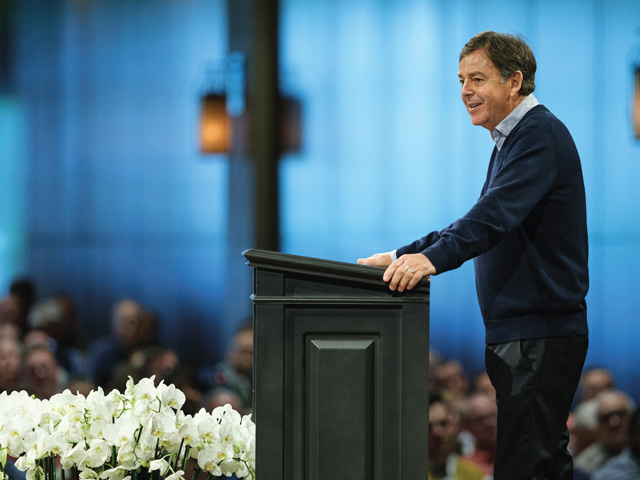
 The Bible reveals that God sometimes uses the wicked to punish His disobedient people. But the good news is that He doesn’t stop there. Find out how He gives His people hope, even in devastation. That's our focus on Truth For Life with Alistair Begg.
-----------------------------------------
• Click here and look for "FROM THE SERMON" to stream or read the full message.
• This program is part of the series A Study in Habakkuk’
• Learn more about our current resource, request your copy with a donation of any amount.
• If you struggle to pray because your mind drifts, you don't know what to say, or you even question if God is listening and able to answer, transform your prayer life by learning to pray like the apostle Paul! ‘Download the free audiobook Pray Big by Alistair Begg.’
Helpful Resources
- Learn about God's salvation plan
- Read our most recent articles
- Subscribe to our daily devotional
Follow Us
YouTube | Instagram | Facebook | X
This listener-funded program features the clear, relevant Bible teaching of Alistair Begg. Today’s program and nearly 3,000 messages can be streamed and shared for free at tfl.org thanks to the generous giving from monthly donors called Truthpartners. Learn more about this Gospel-sharing team or become one today. Thanks for listening to Truth For Life!
Guest (Male): The Bible tells us that God sometimes uses the wicked to punish His disobedient people. But the good news is He doesn't stop there. Today on Truth for Life Weekend, Alistair Begg breaks down the prophecy of Habakkuk to see how the Lord gives His people hope even in devastation. We begin reading at the second verse of Habakkuk chapter 2: Then the Lord replied, "Write down the revelation and make it plain on tablets so that a herald may run with it. For the revelation awaits an appointed time; it speaks of the end and will not prove false. Though it linger, wait for it; it will certainly come and will not delay. See, he is puffed up; his desires are not upright, but the righteous will live by his faith. Indeed, wine betrays him; he is arrogant and never at rest because he is as greedy as the grave and like death is never satisfied. He gathers to himself all the nations and takes captive all the peoples. Will not all of them taunt him with ridicule and scorn, saying, 'Woe to him who piles up stolen goods and makes himself wealthy by extortion! How long must this go on?' Will not your debtors suddenly arise? Will they not wake up and make you tremble? Then you will become their victim. Because you have plundered many nations, the people who are left will plunder you. For you have shed men's blood; you have destroyed lands and cities and everyone in them. Woe to him who builds his realm by unjust gain to set his nest on high to escape the clutches of ruin! You have plotted the ruin of many people, shaming your own house and forfeiting your life. The stones of the wall will cry out and the beams of the woodwork will echo it. Woe to him who builds a city with bloodshed and establishes a town by crime! Has not the Lord Almighty determined that the people's labor is only fuel for the fire, that the nations exhaust themselves for nothing? For the earth will be filled with the knowledge of the glory of the Lord as the waters cover the sea. Woe to him who gives drink to his neighbors, pouring it from the wine skin till they're drunk so that he can gaze on their naked bodies! You will be filled with shame instead of glory. Now it's your turn! Drink and be exposed! The cup from the Lord's right hand is coming round to you, and disgrace will cover your glory. The violence you have done to Lebanon will overwhelm you, and your destruction of animals will terrify you. For you have shed men's blood; you have destroyed lands and cities and everyone in them. Of what value is an idol since a man has carved it or an image that teaches lies? For he who makes it trusts in his own creation; he makes idols that cannot speak. Woe to him who says to wood, 'Come to life!' or to lifeless stone, 'Wake up!' Can it give guidance? It is covered with gold and silver; there is no breath in it. But the Lord is in His holy temple; let all the earth be silent before Him.
Alistair Begg: Our gracious God and loving heavenly Father, we bow humbly in Your presence, knowing that by the Holy Spirit, You have promised to be with us as we gather in the name of Your Son, the Lord Jesus Christ, our risen Savior and our ascended King. As we gather in His presence before the one who is Lord of all the nations and King over all the earth, we recognize tonight that as we represent in some measure the nations of the world, we do good to set an example to our world by being silent in Your presence, by endeavoring to be still and to know that You are God. For our world is in turmoil. The earth groans and creaks. Man's inhumanity to man is unabated despite the passing of time. Empires of our world rise and crash into oblivion. Others emerge out of the ashes and re-establish themselves. And You, oh God, breathe from heaven. The things that man has erected topple and crumble. Men and women's hearts fail them on account of fear, causing them to make idols of their own contriving, to worship at shrines of their own making. And how, when Jesus moved amongst the people of His day and stood and looked on Jerusalem and grieved over it, how often He said, "Would I have gathered you as a hen gathers its chicks, but you would not come to me if only you had known what makes for peace." And surely He looks upon the nations of the world today and says again the same. And You have charged Your people with the good news of great joy for all the peoples, that there has been a Savior born who is Christ the Lord, and that all the expectation of the Old Testament has found its fulfillment in Jesus, the prophet and the priest and the king. And You have sent us out into all the world so that by the good news we proclaim and the good deeds that we do, we may see men and women turning from themselves to Jesus and finding in Christ all that they need and more besides. And so tonight, as we turn to the Bible, unless You are our teacher, then we are of all men and women most miserable. On our best day, we are unprofitable servants. We cannot do anything as we ought without Your help. Therefore, come now and meet with us. Grant to us clarity so that there be no obscurity of the truth that we read on the pages of the Bible. Grant to us a sense of conviction so that we won't read it as if we were reading simply an ancient poem, but as it is the very Word of God. And convert our lives, oh God, we pray. Bring them into conformity with Your Son and with the truth of the Bible. For we ask it in Jesus' name. Amen. We have left Habakkuk standing at his watch in verse 1 of chapter 2, looking to see what God would say in response to his second complaint, waiting to discover the answer that God would provide. We began by noticing that Habakkuk was overwhelmed by the problem of the declension on the part of the people of God. They were tolerating that which God was opposed to, and Habakkuk had approached God and asked Him why it was that He was tolerating this and wondering how long it would be that such tolerance would last. In response, God had answered him in verse 5 of chapter 1, telling him that He was about to do something that he wouldn't believe because He was raising up the Babylonians, or it may read Chaldeans in your version. He was raising up these people to take care of all of the injustice and oppression and disinterest in God that was marked by those who should have known better. That actually wasn't a terrific help to Habakkuk, as it turned out, because he couldn't handle the idea of God somehow or another choosing to use really bad people in order to deal with the problem of quite bad people. As he works out his complaint through chapter 1 and to the end and to the beginning of chapter 2, he's really asking, "Is there going to be any end to the oppression now that is coming by way of the Babylonians? What answer is he going to receive to this complaint?" And that is where we ended last time at the beginning of chapter 2. As he tries to come up with his own answer to the question, he finds that the issue is oppressive. In this respect, he's not unlike the psalmist who, on another day and in another set of circumstances, was confronted by the same kind of thing, only expressed differently. For some of your research, you can read Psalm 73, and you will find it an important and a helpful parallel to what we're considering this evening. There the psalmist says, "I had almost lost my place in the living of life, my feet had almost gone out from under me because I envied the arrogant. And when I saw the prosperity of the wicked and I saw that wicked people could continue being wicked and prosper at the same time, I just couldn't make sense of it. I couldn't understand why it would be that God would tolerate such a thing and why He would not intervene." I'll leave you to read Psalm 73; it resolves towards the end of the chapter in much the same way as we will discover here. Let me say to you again and quite forcibly that although all these events took place long ago and far away from here, they remain instructive for us, helping us to think along these lines. Remember that all of the Scriptures, all of the Bible, is profitable for instruction and for correction and for reproof and for training in righteousness. Not all of the Scriptures are as immediately and obviously applicable as some parts are, but we may be absolutely certain that there is nothing in the Bible that is extraneous and that there is nothing that has been left out of the Bible that is necessary. Some of us who are reading through the New Testament in a year were confronted by the challenge of that when we did the genealogy of the life of Jesus just the other morning. As I sat eating my cereal, I was tempted to skip all the way to the end of it, saying, "Yeah, yeah, yeah." But I deliberately read it all the way through just in order to remind myself of the fact that nothing is in there that is inconsequential or unnecessary. And when you come, for example, to this little prophecy all these 650 or 700 years before Jesus, it is a helpful reminder to us that Christianity, that our Christian lives, are about something far more significant than just how everything relates to us. One of the great dangers that we face is to view the Christian life in distinctly private terms. To become a Christian is, of course, a personal thing, but it isn't a private thing. And in our experience of God's grace to us in Jesus, we discover that it opens up wide vistas to us in relationship to the world in which we live. So that for us to be genuinely Christian is to have our ears open to the cries of the needy, is to have our eyes open to the needs and challenges of our world. And any temptation that we may have to do an Austria at the time of the Second World War needs to be resisted in every way. What did Austria do in the Second World War? They developed as a nation a policy which they referred to as the policy of splendid isolation. Let the war go on all around us, but we will remain isolated from it. Some Christians that I meet have an approach to life which is exactly that. This is about me and about my awareness of Jesus and what He has done and accomplished and how it has affected me and so on. And it doesn't really have much relationship to the world beyond my little tiny world. But that will not do. That will not do. And tonight, if you're a Christian and you read the newspaper, as you should, then presumably you wonder at the struggles in Zimbabwe. You wonder how a nation that is so phenomenally rich in natural resources can be in such an unbelievable shambles. Because you are a Christian, you have thoughts on that. Because you are a Christian, you respond to the circumstances in Burma in a way that you wouldn't were you not a Christian. And when you view the devastating state of affairs in mainland China, you respond as a Christian because your Christian life is far beyond the borders of your home and your heart. So that Christians, of all people, will be asking questions regarding justice and poverty and brutality and immorality as it works itself out in the kingdoms and empires of the world. And if we could find the justification for that nowhere else, then we have all the justification we need in a study of the minor prophets, of which Habakkuk is one. A far more detailed analysis of Habakkuk will be repaid if you endeavor to do it. Our approach in these evenings is about 40,000 feet flying by. I make no apology for it. I determined that this should be my approach, and I'm sticking to it. That's why we're going to the end of chapter 2. It won't take us a long time, but we will get there. I have three points. Number one: the Lord's answer. The Lord's answer. That is pretty easy to get to because it's actually written in the NIV, so I figure that's as good a start as any. Then the Lord replied: "Write my answer large and clear so that anyone can read it at a glance and run to tell others." Write it down. Now, what is he writing down? He's not writing down what is passing through his mind because he may have a fertile imagination as well. The role of the prophet is not to say whatever comes to his fancy, but the role of the prophet is to declare the revelation of God. And the prophets were given direct supernatural revelation in order that they might speak forthrightly to their time and to their day, often not even understanding the depth nor the breadth of that which they conveyed. And that which has been given to us in the prophetic word we now have more certain in the Word of God, inscripturated. So that always the people of God are listening to the revelation of God—the declaration, the manifestation of Himself in His world, in His Word, and in His Son. And this revelation, which is the answer to Habakkuk's question, God tells him is marked by four things. Let me just point them out to you. Number one: write down the revelation, make it plain so that someone can run and read it. For the revelation, number one, awaits an appointed time. From Habakkuk's position, everything else is just going on as usual. And from his perspective, it just seems as though history is entirely cyclical. It looks as though it's going around and around and around. God says, "No, I want you to write this down, write it down clear. What I am doing has an appointed time. I haven't disclosed the time to you, but I know what the time is. Trust me." Number two: it speaks of the end. Incidentally, the appointed time for the end of the Babylonians, we now know, was 539 BC when He raised up the Persians to come in and give the Babylonians their hiding. But you can read that in your history books. It awaits an appointed time. It speaks of the end. You'll see that there in verse 3. It will not prove false. And though it apparently lingers, wait for it; it will certainly come and will not delay. Now, Habakkuk has to take all of that as per God's word to him. And we could apply that, of course, in many ways and have benefit from considering its truth in relationship to all that still awaits the unfolding of God's purpose in terms of the end of time and the return of Jesus and so on. Now, in verses 4 and 5, He contrasts the righteous life, which is lived by faith, with the proud boasts and the activities that mark those who are puffed up and live for themselves. And this is a pretty difficult little section here, as it turns out, but the best I can do with it is this: that when He says, "See, he is puffed up," either what we have is the epitome of the Babylonian or, if you like, the description of the ruler of the Babylonians as being emblematic of that entire people. He is puffed up. He's on the wrong track. He is betrayed by wine, or it may actually be wealth—both words are similar in Hebrew and the translators disagree over it. So let's just say both. The puffed-up individual is betrayed both by wine and by wealth. He's arrogant, never at rest, greedy, dissatisfied, and he swallows nations whole. He just gobbles them all up as he goes. So from the Lord's answer, we turn to the Lord's judgment. The Lord's judgment. And the Lord's judgment is expressed in a succession of five woes. Woe! You may remember in Matthew chapter 23 that Jesus uses the same mechanism when He gives the Pharisees a jolly good ticking off. "Woe to you," He says. "You do this and you do that and you shouldn't." He's employing this Old Testament mechanism. And here in these five areas, He pictures people taunting the proud boasts of this apparently unconquerable force. Now, what I've done is I've just tried to give a heading to each of these five, and we daren't work our way through them or we'll be here long into tomorrow morning. And if you don't like my heading, get your own heading. All right? First of all, in verses 6 to 8: injustice. Injustice. Woe to him who piles up stolen goods and makes himself wealthy by extortion. You have plundered, verse 8, many nations. In other words, he sounds out a woe to the nation that has conquered lands to which it has no moral right, that has gone and taken for itself something that doesn't belong to it for whatever reason, usually on the strength of tyranny or the desire simply to have more than we have. Tempted to pile up stolen goods, guilty of dealing unfairly, being involved in extortion. You will find all these words and notions in this little section, 6 to 8. And what He says is, "What you've piled up will come down on your head. You thought it was a great idea to come in here and vanquish these people and plunder these people and take over everything and call it your own? Well, guess what? It'll come down and land on your head."
Guest (Male): You're listening to Truth for Life Weekend with Alistair Begg and a message titled "Let All the Earth Be Silent." We'll hear the conclusion next week. Habakkuk's cry, "How long, oh Lord?" isn't unique to Old Testament days. It's just as familiar to us today. And we hope that this study of prophecy is helping you trust and wait on the Lord. If you'd like to hear Alistair's teaching through the entire book of Habakkuk, or if you'd like to share the teaching with a friend in trying circumstances, you can stream or download the complete series on our website at truthforlife.org. It's simply titled A Study in Habakkuk. On our website, you can also check out a book we are currently recommending. It's called Stand in Awe: How Reverence Transforms Our Worship and Our Lives. There are many Bible verses that talk about having reverence for God, but have you ever wondered what that really means? Worship leader, singer-songwriter Laura Story explores this topic in a brand new book, and she shows what it means to live and worship in the reality of God's perfect, holy character. To find out more about the book Stand in Awe, visit our website at truthforlife.org. Thanks for studying the Bible with us. Next week, we'll learn about God's promise to deal with wicked oppressors. The Bible teaching of Alistair Begg is furnished by Truth for Life, where the learning is for living.
Related Episodes
A Day in the Life of Jesus (Part 2 of 3)
Friday, September 18
A Day in the Life of Jesus (Part 1 of 3)
Thursday, September 17
Jesus: His Message and His Mission (Part 2 of 2)
Wednesday, September 16
About Truth For Life
Truth For Life distributes the unique, expositional Bible teaching of Alistair Begg. Studying God’s Word each day, verse by verse, is the hallmark of this ministry. In a desire to share the good news of the Gospel without cost as a barrier, the entire teaching archive is available for free download and resources are available at cost with no markup.
About Alistair Begg
Alistair Begg has been in pastoral ministry since 1975. Following graduation from The London School of Theology, he served eight years in Scotland at both Charlotte Chapel in Edinburgh and Hamilton Baptist Church. In 1983, he became the senior pastor at Parkside Church near Cleveland, Ohio. He has written several books and is heard daily and weekly on the radio program, Truth For Life. The teaching on Truth For Life stems from the week by week Bible teaching at Parkside Church. He and his wife, Susan, were married in 1975 and they have three grown children.Contact Truth For Life with Alistair Begg
Website
http://www.truthforlife.org/?utm_source=oneplace&utm_medium=sitelinks&utm_campaign=home
Mailing Address
Truth For Life
P.O. Box 398000
Cleveland OH 44139
Telephone (Customer Service)
888-588-7884 Domestic
400-543-6800 International
440-543-0522 ( Fax)


