The Sermon On The Amount – Part 1 of 2
Ministries > Running To Win with Dr. Erwin W. Lutzer
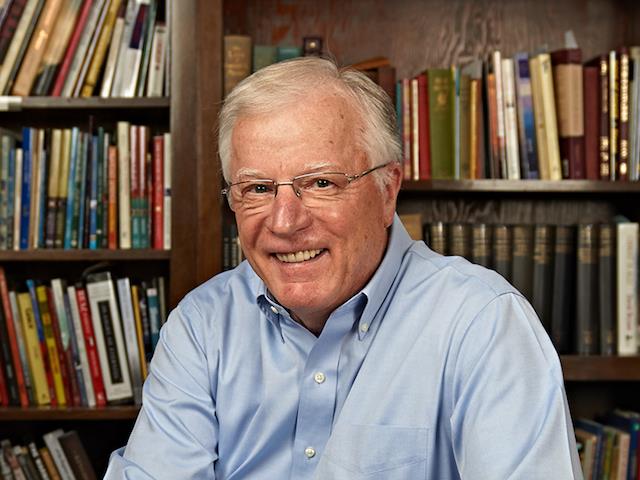
Prosperity-gospel preachers too often twist giving into a get-rich scheme. So, how much should we give? In this message from 2 Corinthians 9, Pastor Lutzer provides three principles that answer the question without naming a percentage. Discover the harvest God promises: something money can’t buy.
Dave McAlister: Let us run with endurance the race that is set before us, looking to Jesus, the founder and perfecter of our faith. Some churches demand their members give a tithe or 10% of their paychecks. Others ask for the tithe plus more as in tithes and offerings. What does God expect of believers when the plate is passed? Today, why the bottom line is determined based on the principle, that of sowing and reaping. From the Moody Church in Chicago, this is Running to Win with Dr. Erwin Lutzer, whose clear teaching helps us make it across the finish line. Pastor, your focus today is the sermon on the amount. It's so easy to think that what's in our wallets is ours, not God's. So, who sets the level of our giving?
Dr. Erwin W. Lutzer: You know, Dave, I want to answer that question by saying God and you. You set the level of your giving. I stress that because there are many churches that emphasize 10%. It's a good starting point in giving, but it's not a New Testament requirement. This was required in the Old Testament times. So we here, for example, at the Moody Church like to emphasize that it is a decision made between you and God. And of course, it may be much more than 10%. Again, it has to do with where you are at and the amount that God lays on your heart to contribute. And speaking about contributing, we're almost to the end of the month and this is a very special month here at Running to Win. It's really the end of our fiscal year. And also during this month, every gift that is given, we double. There are people who are committed to doubling every gift you contribute, dollar for dollar. And also this month, as our thank you, we're making a very special gift available. For now, let us listen to God's word. Every few years, I quote this poem, and I think that in light of my message, it should be quoted again today. A big silver dollar and a little brown cent rolling along, together they went. Rolling along the smooth sidewalk when the dollar remarked, "For the dollar can talk, you poor little cent, you cheap little mite, I'm bigger than you and more than twice as bright. I'm worth more than you a hundredfold and written on me in letters bold is the motto from the pious creed, in God we trust, which all can read." "I know," said the cent, "I'm a cheap little mite and I'm not good nor big nor bright." "But," said the cent, with a meek little sigh, "You don't go to church as often as I." Today I'm speaking on the sermon on the amount. Everyone wonders. Yeah, yeah, you're catching on. Everyone wonders, how much should we give? Well, today I want to help you from God's word. The Old Testament, there was a 10% requirement called a tithe, but it was a requirement. It was like a tax. When you fill out your income tax, the IRS doesn't say, "Well, you know, how much would you like to give this year? Why don't we have a stewardship day and see what your commitment is?" No, the IRS says, "Pay up or you're dead meat," or something like that. So the thing is that in the Old Testament, it was a requirement. And beyond that tithe or that tax, there were offerings, and there were even other tithes and so forth. So people often wonder, should we translate, should we transfer that Old Testament context to the New? Well, in the New Testament, we know that there's a sense in which God does have a higher standard. And we are to give the way in which we are prospered. But the New Testament does not specify, specifically a percentage. It goes to the heart of the matter and gives us principles by which if we follow those principles, God will show us how much we should give. The context of Second Corinthians, and if you have your Bibles, I'd appreciate if you would turn there, Second Corinthians chapter 9. The Apostle Paul wanted to raise an offering from the Corinthians for the saints in Jerusalem. Now, many of the Jerusalem folks were Jewish people. And the Apostle Paul not only wanted to help the poor, which was a great motivation for giving, but there was more to it as well. Paul wanted to bind together Jew and Gentile by means of this offering. There's nothing that brings people together as when wealth and resources are shared. And so Paul is talking to the Corinthians who made a promise, but they had not followed through. You'll notice in Second Corinthians chapter 8, he says in verse 10, "And here is my advice about what is best for you in this matter. Last year you were the first not only to give but also to have the desire to do so. Now finish the work so that your eager willingness to do it may be matched by your completion of it according to your means." Paul says, "You agreed to give an offering and now the offering has not really been taken. You've not made your commitments." A great deal of relevance for us. It's easy to make a promise and to say, "Well, we have made a promise, but we have not followed through." Paul says, "Follow through so that it may be completed." Now, in order to motivate them, he used the Macedonians as we noticed last time. He used Jesus Christ, who though he was rich, yet for your sakes he became poor so that you through his poverty might become rich. And now what he wants to do is to motivate us as he has recorded this in God's most holy word. Paul elevates giving. He calls it in this passage a ministry, a fellowship. He even refers to it as a debt, as the fruit of Christian love, and throughout the text, he keeps speaking about the unique grace called giving. Now, what I'd like to do is to ask you now to look at chapter 9 and we are going to pick it up at verse 6. Paul in encouraging people to give, chooses the metaphor of a farmer. And having chosen it, he gives us principles that will help us to know how much we should be giving. You'll notice he says in verse 6, "Remember this, whoever sows sparingly will also reap sparingly. And whoever sows generously will also reap generously." Three principles. Principle number one, the example of Jesus Christ. Yes, but the first principle is to sow generously. Sow generously. Because we reap what we sow. Paul is saying, if you sow stinginess, you're going to reap stinginess. Elsewhere he says, if you sow to the flesh, you shall of the flesh reap corruption. If you sow to the spirit, you will of the spirit reap everlasting life. You sow generously, you will reap generously, because we reap more than we sow. Back on the farm, there were times when farmers might have an implement that was to be doing the seeding and maybe it got stuck. Maybe the grain got stuck, and so the wheat was not being put into the ground. Sometimes the farmers perhaps didn't know it until they had done part of the field. But in the fall, when harvest time came, if there was no seed or sparse seed, there was a very sparse harvest. We used to take grains of wheat and count the number of kernels, and one kernel of grain sometimes produced up to 30 kernels of wheat. And Paul is saying that if you sow sparingly, you will reap sparingly. If you sow generously, you will reap generously. So the first principle is to sow generously. And if you're wondering how much you should give to God and to his work, there's a question you have to ask, "What kind of a harvest do you want?" Do you want a bountiful harvest, or would you be satisfied with a sparse harvest? That's the first principle. Second principle, sow cheerfully. The text says in verse 7, "Each man should give what he has decided in his heart to give, not reluctantly or under compulsion, for God loves a cheerful giver." Now, a farmer, it doesn't matter what his motive is when he seeds. As long as there's rain, as long as the soil is good, as long as God does not send him any hail, he's going to have a crop, no matter what his attitude was on the day that he planted it. But this is a different kind of seeding and a different kind of harvesting. So Paul says, "I want you to do it with the right attitude." He said, "Do not be a sad giver. Don't give grudgingly or reluctantly." And I need to say that to you today. That God has to do a work in our heart so that we can give cheerfully, most assuredly. "Do not be a sad giver, do not be a mad giver." He says, "Do not do it of necessity or as this translation says, don't do it under compulsion." If you're here today saying, "Well, stewardship enrichment, they can just do whatever they want to do. I don't want to get involved in this. That's their program." Well, then maybe you shouldn't give at that point. Because Paul says, "Don't be a sad giver, don't be a mad giver, but be a glad giver." Why give cheerfully? Because God gave cheerfully. "He that spared not his own son, but delivered him up for us all, how shall he not also with him freely give us all things?" God gives cheerfully. Therefore he says we should as well. I have a friend who's a pastor, who tells his congregation quite often, more often than I think he should. "God loves a cheerful giver but will take money from a grouch," he says. Now, I've thought about that statement quite a bit because I've heard him say it a number of times and I may have used it here at the church a couple of years ago, but I feel a little uneasy about it. But here's my analysis of it. If you're a grouch and you give, there's no doubt that God can take that gift and use it. God will bless it. God will invest it. It will have an impact in the lives of people, it will support missionaries, it will help children. It will take care of responsibilities and salaries in the ministry. It will be blessed. But God can bless the gift, but he cannot bless the giver. And therefore, don't give grudgingly or of necessity. Be a cheerful, cheerful giver. Desire to give more than you can give. A couple of weeks ago, a woman in this congregation, an African-American woman, after the service came to me and she said, "Pastor." And the moment she began to talk, she began to cry. Tears were coursing down her cheeks. "See," she said, "I want you to know that for years I've given 10% to this church. I've given my tithe and now I want to double it for stewardship enrichment, but I don't think I'm going to be able to afford to do it." I looked at this dear lady and I said, "Don't feel under compulsion to double the amount that you are giving." I said, "Your tears are testimony to the fact that you are a cheerful giver and you would desire to give more." And God will honor that. If more of us wept, saying, "You know, we have a certain amount that we can give, but we're crying because we want to give more." How precious that would be to God. And I will tell you for sure that our need and our goals and our aspirations at this church would be fully met. God loves a cheerful giver, and those tears were a sign of love and cheerfulness. Well, we've learned, the first principle is you must sow generously. So if you're wondering how much to give, ask yourself the question, "What kind of a harvest do I want?" But there's a second principle, and that is to give cheerfully. Ask yourself a second question, namely, "What kind of a heart do I have?" Those who love God, love to give. And God loves those who give hilariously, cheerfully. Well, there's a third principle, and that is we should sow expectantly. Now, the question is, what kind of a harvest are you going to have? What is God going to give you in return? In the Old Testament, it was primarily wealth. There was a tight connection between the spiritual life of the nation and the way in which God blessed them on their crops. He said, "If you follow me and serve me," he said, "I will bless you and your barns are going to be filled with plenty, and you're going to have all that you can possibly have. But if you turn away from me as a nation," the Lord says, "I will send grasshoppers. I will send hail. I will send drought." That's not true today, you know. Because God is no longer dealing with us as a nation, he's dealing with us as individuals and he is creating a transnational community, a community of Jews and Gentiles, a community with different races and cultural backgrounds. And that's why we have here at the Moody Church our desire to be known as a culturally diverse community, not theologically converse, but culturally diverse, because we know that God is choosing people from every tribe and people and nation. So he no longer deals with us in that tight relationship. This is possibly the best place for me to comment on so-called TV preachers. I actually thought that they no longer existed, the kind that we sometimes refer to. And I was surprised to discover that there are some people on television who are saying things that are so wrong, that are so demeaning to God, that are so manipulative. I hope that you are aware of them. I hope that you warn others about them. You know that if you give, God is going to give back to you. If you send to this ministry, this is the seed faith and soon you're going to be driving that pink Cadillac. I heard the other day, I couldn't believe this, somebody who should know better. They were praying to break the curse of debt. They were asking God to break the curse of debt. And especially if you sent money to the ministry, why indeed the curse of debt will be lifted right away. And not only that, I heard one preacher say, this is unbelievable, folks. I don't understand how there are Christians who listen to this kind of demeaning theological talk. He said that in effect, if you send money to my ministry, you'll discover that God will pay your bills, and you'll receive a computer printout from your mortgage company saying, "We don't know how it happened, but our books show that your house has been paid for." Utter nonsense. If you are in debt, I'll tell you how to break the curse of debt. First of all, you take care of those credit cards in the plastic surgery that I talked about a couple of weeks ago. That's one good step. The second step is begin to pay your debts. Get to a financial advisor who can help you to know how those debts should be paid over a period of time. And that's the way you get out of debt. You don't send money to some TV preacher so that he can pray for you to break its curse. It is a curse, but you got into it, and you and God and your financial advisor had better get you out of it. That's the answer. So we're not here crassly talking about that if you sow money, I promise you tenfold. I promise you that for every dollar you give, you're going to get another ten in return. Listen to me, I've got something better to share with you than that from this text. Let me tell you something. I marvel at what the Apostle Paul says here. In fact, I not only marvel at it, I almost don't understand it. Because Paul is saying that if you sow money, God is going to give you a harvest, but the harvest is going to be something that is better than money and something that money can't even buy. Now, there will almost always be financial return. But it doesn't mean as if to say that's why we give or that we are giving our way to prosperity as the title of one book reads. Paul says, God's got something in store for you that money can't buy. So, what is the third principle? We've learned that we sow generously, we sow cheerfully, we sow expectantly. Expectantly because we know it takes faith to sow. Because you're kissing the seed goodbye. You're putting the seed in the soil and that takes faith. But notice the harvest that God gives us. What is it? Well, I've categorized it under three different ways to describe it. First of all, he says the harvest of sufficiency in all things. Verse 8, I am astounded at the universals in the verse. In fact, I think that little word "all" or its equivalent appears about three times for sure and maybe four. Listen to what he says, "And God is able to make all grace abound to you so that in all things at all times, having all that you need." Isn't that four times? Notice then, "You will abound in every good work." I read that and I'm astounded. I'm saying, "Paul, are you telling me that if I'm faithful in giving money, I am going to experience a sufficiency of God that money cannot buy? That I will find that well of water within me reaching up to eternal life?" Because the idea here in the Greek is that it will be a matter of inner resources so that I will be able to suffer better, so that I will be able to face life better, so that I will have more wisdom and abound in all things. That's what Paul says is one of the harvests of those who give generously. Isn't that amazing? And of course, to use a different figure of speech, the Apostle Paul in this context says, "If you sow sparingly, you reap sparingly." The whole point again is to emphasize that God loves generosity. And so what we want to do is to be generous people. So that God can continue to bless us and to bless other ministries. And of course, I know that all those who are listening, you have many opportunities to contribute. We hope that you'll pray about a very special gift to the ministry of Running to Win, even during this month which is coming to a close. Why? Well, it's the month in which we double all contributions that are made to us. We have those who are committed to say, they will double your gift. Just imagine that. And as a thank you, we are going to be sending you a copy of my book, "Christ Among Other Gods." I sure hope that you have a pen or pencil handy, because in a moment, I'm going to be giving you some contact info. But "Christ Among Other Gods" was written at a time when I was attending a conference in Chicago, attempting to unify all the religions of the world. And during those days, I had the opportunity of proving that Jesus Christ is totally, completely unique. Well, this book can be yours. But first of all, let me give you that contact info. Go to rtwoffer.com. That's rtwoffer.com. By the way, when you're there, you can also click on the endurance partner button to see how you can contribute regularly. rtwoffer.com or pick up the phone and call us at 1-888-218-9337. My friend, I want to emphasize this. It's because of people just like you, the ministry of Running to Win is going around the world and we continue to expand.
Dave McAlister: It's time once again for you to ask Pastor Lutzer a question about the Bible or the Christian life. The Christian faith grew out of the Jewish faith. In fact, Paul likens the church to a branch whose roots go back to ancient Israel. Michael listens to our program and wants to know this. How do Jewish holy days apply to us as Christians? Should we observe them?
Dr. Erwin W. Lutzer: Michael, I think the key to your question actually surrounds the word observe. If you mean should we acknowledge them, should we learn from them? The answer is yes. If by observing them you mean that we should observe them as the ancient Jews did, I don't think so. In fact, let's take for example, the Day of Atonement. When you go back in Old Testament times, you realize that this particular day is a wonderful illustration of redemption. And certainly we can contrast that with the New Testament, where we have the privilege of being in God's presence and where the veil of the temple was rent in two. So we should learn from the Jewish holy days. We should study them. We should understand them. But as pictures that in effect predicted the coming of Jesus Christ and the larger fulfillment in the New Testament. So, if you define the word "observe" as acknowledge and learn from, yes, observe in the general sense of the word, no.
Dave McAlister: Michael, thank you for your question. And thank you, Dr. Lutzer. If you'd like to hear your question answered, you can. Just go to our website at rtwoffer.com and click on ask Pastor Lutzer or call us at 1-888-218-9337. That's 1-888-218-9337. You can write to us at Running to Win, 1635 North LaSalle Boulevard, Chicago, Illinois 60614. That was Erwin Lutzer introducing the Sermon on the Amount, the fifth in a six-part series on managing God's gifts. Next time on Running to Win, why after sowing generously and cheerfully, more on why we should sow expectantly. Plan to join us. Thanks for listening. For Pastor Erwin Lutzer, this is Dave McAlister. Running to Win is sponsored by the Moody Church.
Related Episodes
The Sermon On The Amount – Part 2 of 2
Friday, August 28
Myths About Money – Part 2 of 2
Wednesday, August 26
Myths About Money – Part 1 of 2
Tuesday, August 25
Related Videos
About Running To Win
Running the race of life is hard. But with the Bible front and center and a heart to encourage, Pastor Erwin Lutzer presents clear Bible teaching, helping you make it across the finish line. Since 2011, this 25-minute program has provided a Godward focus and features listeners’ questions.
About Dr. Erwin W. Lutzer
Dr. Erwin W. Lutzer is Pastor Emeritus of The Moody Church where he served as the Senior Pastor for 36 years (1980-2016). He earned a B.Th. from Winnipeg Bible College, a Th.M. from Dallas Theological Seminary, a M.A. in Philosophy from Loyola University, and an honorary LL.D. from the Simon Greenleaf School of Law (Now Trinity Law School).
A clear expositor of the Bible, he is the featured speaker on two radio programs: Running to Win—a daily Bible-teaching broadcast and Songs in the Night—an evening program that’s been airing since 1943. Running To Win broadcasts on a thousand outlets in the U.S. and across more than fifty countries in seven languages. His speaking engagements include Bible conferences and seminars, both domestically and internationally, including Russia, the Republic of Belarus, Germany, Scotland, Guatemala, and Japan. He has led tours to Israel and to the cities of the Protestant Reformation in Europe.
Pastor Lutzer is also a prolific author of over seventy books, including the bestselling We Will Not Be Silenced, One Minute After You Die, and the Gold Medallion Award winner, Hitler’s Cross. Pastor Lutzer and Rebecca live in the Chicago area and have three grown children and eight grandchildren. Connect with Pastor Lutzer on X (@ErwinLutzer) or moodymedia.org.
Contact Running To Win with Dr. Erwin W. Lutzer
Mailing Address
Moody Church Media
1635 North LaSalle
Chicago, IL 60614
Toll-free Phone Number
1.800.215.5001
Monday – Friday
8:00am – 5:00pm CST
Fax Number
1.312.642.4904


